
About mkd
The Science of Mevalonate Kinase Deficiency
Mevalonate Kinase Deficiency (MKD) is a severe genetic metabolic-autoinflammatory disease caused by a mutation in the MVK gene. This defect disrupts a core biochemical pathway, leading to a profound systemic imbalance: a toxic accumulation of mevalonic acid and a critical depletion of isoprenoids—the signaling molecules essential for immune regulation.
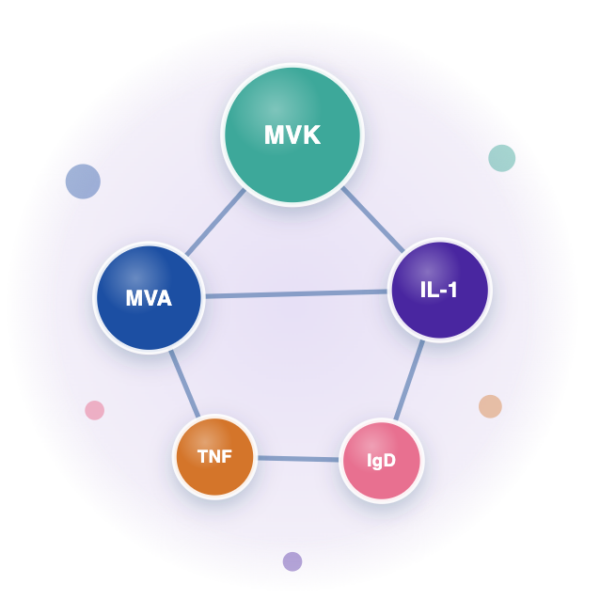
Disease Deep-Dive
Imagine every cell in your body as a high-tech factory. This factory contains a production line called the mevalonate pathway, which converts basic building blocks into molecules called isoprenoids that help immune cells function normally.⁵ The pathway produces two major classes of molecules: Nonsterol isoprenoids and Sterol isoprenoids (including cholesterol).4
In a healthy cell, the mevalonate kinase enzyme acts as a key machine early in this production line. It helps move raw materials through the pathway so the cell can produce important downstream molecules that help regulate inflammatory responses in immune cells.5
In a person with MKD, this “machine” does not work properly because of variants in the MVK gene. The enzyme may retain anywhere from undetectable to about 20% of normal function.3
Additionally, the mevalonate kinase enzyme is temperature sensitive. During infections or stress—when body temperature rises—enzyme activity may decrease further, worsening the metabolic defect and triggering flares.4
MKD is a disease that exists as a spectrum, known as Hyper-IgD Syndrome (HIDS) on one end and Mevalonic Aciduria on the other. Enzyme activity varies across this spectrum.
The cell struggles to produce enough isoprenoids required for a process called protein prenylation. Prenylation helps certain proteins attach to cell membranes like an anchor, allowing them to properly regulate immune signaling 3,5 When prenylation is impaired, immune signaling pathways become dysregulated, triggering the recurrent inflammatory attacks seen in MKD.4

Hyper-IgD Syndrome (HIDS): With greater enzyme activity present, HIDS was historically described as the milder end of the spectrum. This assumption may be incorrect, as HIDS patients can also experience life-altering consequences. Patients experience periodic inflammatory attacks (fever, swollen lymph nodes, rashes) but may also feel relatively well or be asymptomatic between attacks.6
Mevalonic Aciduria (MA): The severe end of the spectrum, when enzyme activity is extremely low or undetectable, inflammation may be persistent, and patients can develop complications such as developmental delay, poor motor coordination (ataxia), and neurological involvement.3
Diagnosis and Prevalence
The classic symptoms of Mevalonate Kinase Deficiency (MKD)—recurring fever, skin rashes, abdominal pain, and joint pain—can closely mimic common childhood infections and other inflammatory conditions. As a result, the path to a diagnosis is often a “medical odyssey” for families.¹
In many reported cohorts, patients experience an average of 5 to 7 years of diagnostic delay before receiving an accurate name for their condition.² During this time, patients may experience ongoing uncontrolled inflammation, which may contribute to long-term complications affecting organs such as the kidneys, liver, or nervous system.¹
Earlier recognition and genetic testing of the MVK gene can dramatically shorten this timeline.³ Diagnosis is confirmed by a reduction in biochemical activity of the mevalonate kinase enzyme, typically ranging from undetectable to 20% of normal activity.3,4

MKD is an ultra-rare condition. It is estimated that approximately 300 cases have been reported in medical literature worldwide.12,13 This is likely an underestimate, as many patients remain undiagnosed due to the rarity of the condition and limited access to widespread genetic screening. There is also a lack of uniform data entry globally to ensure all MKD patients are accounted for. This is one of the key areas Cure MKD will focus on moving forward.
Typical Treatments
Current treatments focus on controlling the immune system’s overreaction since the underlying metabolic defect cannot yet be directly corrected.
IL-1 Blockade (First-Line Therapy): Medications such as anakinra and canakinumab target Interleukin-1 (IL-1), an inflammatory signal that plays a central role in MKD flares.7,8,9
TNF Inhibitors: Drugs such as etanercept target TNF-alpha. They may be less consistently effective than IL-1 blockade in severe disease.7
Stem Cell Transplantation: For the most severe cases, hematopoietic stem cell transplantation (HSCT) has been attempted, generally reserved for life-threatening complications.10
Key Takeaways
Metabolic & Immune
MKD disrupts an important metabolic pathway, causing a shortage of isoprenoids that leads to immune system overactivation.
The Spectrum
MKD exists on a continuum from periodic fever (HIDS) to severe neurological involvement (MA).
Early Action
Genetic testing and enzyme assays are essential to confirm MKD and help patients access specialized care sooner.
Written by: By: Jack Drda
Scientific Sources:- Frenkel J, et al. Clinical and molecular variability in mevalonate kinase deficiency. Ann Rheum Dis. 2001.
- Mulder JW, Frenkel J, Wulffraat NM. Diagnostic delay in rare autoinflammatory diseases. Eur J Pediatr. 2018.
- Drda J, Ballout R, Hamidi LN, Lanthier S, Batu ES, Steiner RD. Mevalonate kinase deficiency. MedLink Neurology. 2025.
- Muñoz MA, Skinner OP, Masle-Farquhar E, et al. Increased core body temperature exacerbates defective protein prenylation in mouse models of mevalonate kinase deficiency. 2022.
- Rogers MJ, et al. The mevalonate pathway and protein prenylation in cell signaling and inflammation. Biochem Soc Trans. 2011.
- Brogan PA, Frenkel J, Kastner DL. Pediatric autoinflammatory diseases: An update. Rheumatology. 2016.
- Lengvári L, et al. Mevalonate kinase deficiency: Updated clinical overview and revision of the SHARE recommendations. Front Immunol. 2024.
- Romano M, et al. 2021 EULAR/ACR points to consider for IL-1 mediated autoinflammatory diseases. Ann Rheum Dis. 2022.
- De Benedetti F, et al. Canakinumab for autoinflammatory recurrent fever syndromes. N Engl J Med. 2018.
- Neven B, et al. Allogeneic hematopoietic stem cell transplantation in mevalonate kinase deficiency. Blood. 2010.